
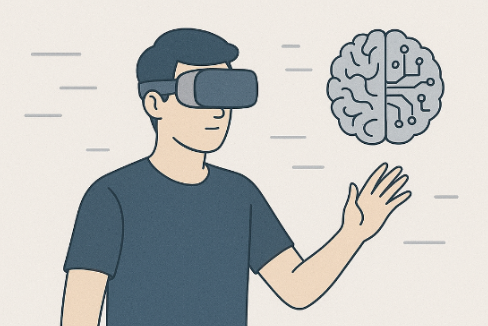

Virtual Reality (VR) and Artificial Intelligence (AI) once seemed like concepts of tomorrow—they will soon be central to designing curriculum and learning experiences. VR places learners in completely immersed, interactive environments where they can practice, discover, and experiment in a realistic but protected environment. AI operates like an Intelligent Personal Learning Companion: it accelerates or decelerates the pace, changes the material, and reacts personally to each student’s preparation and needs. Together, they create “intelligent virtual labs” that reach beyond a typical brick-and-mortar-classroom.
A New World Awaits Engineering Students
This partnership has massive potential for engineering research. Abstract concepts and advanced theories difficult to grasp in a conventional lecture can be made experiential in VR simulations. Students can carry out experiments that would be too costly, too unsafe, or too impractical on a logistical level. Analytics powered by AI provide immediate feedback and tracking of student activity in actual time, such that learning pathways can be adjusted on a daily basis. Students aren’t only grasping concepts but confidently practicing them.
Image created with ChatGPT (DALL·E, OpenAI), 2025
Eliminating Barriers
One of the most exciting aspects of VR and AI in education is that they can be a more inclusive and accessible way to learn. Many students around the world have barriers—the financial, geographical, or physical kind—that limit their potential. With these tools, personalized and immersive learning is within reach of a broader population. VR and AI act to close inequalities due to the fact that they extend opportunity regardless of cultural, linguistic, or socio-economic diversity.
Redesigning Teachers’ Roles
The future classroom changes the role of the teacher too. With subject matter instruction and grading available to be taken over by computerized systems of artificial intelligence, teachers need no longer be bound to such matter-based instruction and can become guides and mentors. Time can be spent on higher-order skills—the supported development of creativity, encouragement of critical thought, and enabling ethical judgment. This avoids human interaction becoming lacking in education but instead positions it where it can have maximum impact, and places technology in service to efficiency and tailoring.
Towards a Smarter More Equitable Future
It’s not just a technology innovation—but a real education revolution. Blending virtual reality with intelligent adaptation, these tools make better instruction and learning possible. For engineering and beyond, they sketch out a vision of smarter, better-motivated, and more inclusive classrooms. And in doing so, VR and AI move us closer to a world where quality education is within reach of all learners.
Author
Gökhan GÜRBÜZ
Early Stage Researcher in VILLAGE Project
Ph.D. Candidate, Ege University


No responses yet