


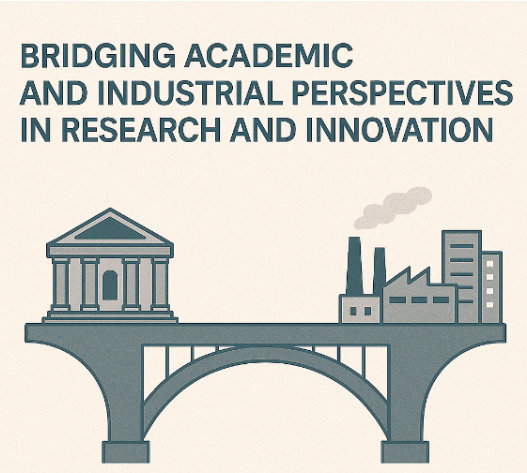
Innovation and scholarship do best when diverse perspectives converge. Academia and industry once were two separate worlds: one of long-term knowledge construction, conceptual thinking, and intellectual seriousness, and the other of short-term implementation, scalability, and market demands. If these perspectives do not converse with one another, both give up their best potential. But when academia and industry converge with each other directly, they produce a dynamic system that combines depth with relevance, theory with practice, and discovery with execution.
Academic institutions provide the necessary foundation for innovation through their emphasis on scientific output, methodology and the development of new concepts. This knowledge base ensures that new technologies and techniques emerge from solid evidence. Industry provides relevance and immediacy, translating hard study into products, processes, and services that arrive to fulfil societal and economic needs directly. Merging these two realms renders innovation scientifically sound, not just, but socially and economically efficient too.
Academia and industry do not necessarily align on common goals, with separate priorities and criterias of success. Academic researchers value publishability, conceptual novelty and ultimate contribution. Industry, on the other hand, focuses on profit, efficiency and short-term outputs. Therefore, successful collaboration requires openness, flexibility and mutuality. By conciliation expectations, open methods for intellectual property and knowledge transfer must be agreed upon. By establishing a culture of respect, both parties have the potential to overcome structural barriers.
Finally, combining scholarly and industrial thinking creates an innovation system larger than its constituent parts. By leveraging each other’s unique capabilities, it can create sustainable products for solving world problems, propel economic growth, and push scientific frontiers further. With knowledge and application forming tighter interconnections in our world, collaborative activities between academic and industrial realms are not only useful but mandatory for charting future directions of innovation and research.
Author
Mehmet KARA
Early Stage Researcher in VILLAGE Project
Ph.D. Candidate, Ege University


No responses yet