

Engineering Meets Education: A Cross-Disciplinary Perspective on Instructional Design for Virtual Laboratories
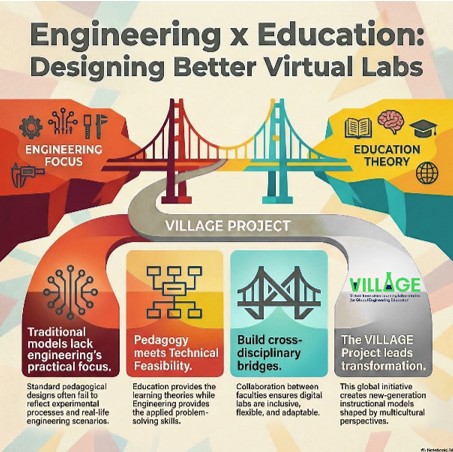
Collaboration between engineering education and educational sciences has become increasingly important, especially with the rise of digitalisation, virtual reality (VR), and virtual laboratory applications. Traditional instructional design models are mainly developed from a pedagogical perspective. They offer a strong theoretical base for structuring learning processes. However, they often do not fully capture when it comes to reflecting the nature of engineering education. Engineering learning relies heavily on practical application, experimentation, and real-life problem solving. These aspects are not always fully captured by existing models. This gap becomes even more visible when engineering laboratories are transferred into digital environments.
For this reason, collaboration between engineering faculties and faculties of education is essential. Such interdisciplinary work allows instructional design models to be reconsidered and expanded. Educational sciences contribute knowledge on learning theories, assessment methods, and student diversity. Engineering, on the other hand, brings technical depth, applied learning, and problem-solving skills. When these two fields come together, they create learning designs that are both pedagogically strong and practically applicable.
The VILLAGE (Virtual Innovative Learning Laboratories for Global Engineering Education) project is a clear example of this approach. In the project, academic staff from engineering faculties work together with experts from educational sciences. Their goal is to develop new instructional design models tailored for virtual laboratories. This collaboration helps ensure that the models are not only theoretically sound but also flexible and based on real needs. In addition, the involvement of experts from different countries and disciplines brings a multicultural and multidisciplinary perspective to the process.
The future of engineering education depends not only on new technologies but also on how these technologies are used in teaching. It is not enough to introduce tools like VR. They must be supported by strong instructional design. Therefore, collaboration between engineering and educational sciences is essential. Projects like VILLAGE show how this transformation can be achieved in practice.
Author
Mehmet KARA
Early Stage Researcher in VILLAGE Project
Ph.D. Candidate, Ege University


No responses yet