

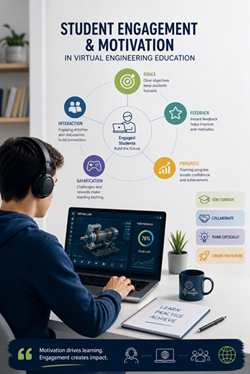
Student Engagement and Motivation in Virtual Engineering Education
Engineering education is, by its very nature, a field of study that involves active participation, hands-on learning, and problem-solving processes. However, the accelerating pace of digitalization and the shift of educational environments to online platforms—particularly in the post-pandemic era—has brought the issues of student engagement and motivation back into focus. The interaction that naturally occurs in traditional classroom and laboratory settings may not be achieved to the same extent in virtual environments. Therefore, developing new approaches to enhance student participation in virtual engineering education is of great importance.
The widespread adoption of online and virtual learning environments has made the question of how students engage in the learning process even more critical. Particularly in practice-oriented fields such as engineering education, students are expected to be active participants in the process rather than merely passive listeners. In this regard, virtual laboratories, simulations, and interactive digital platforms play a significant role. Thanks to these tools, students can repeat experiments, experience different scenarios, and observe results in real time. As a result, the learning process becomes more dynamic, while students’ interest in the course and their level of participation also increase significantly.
Technology plays a significant role in boosting student motivation. Digital tools such as gamification, real-time feedback systems, and personalized learning paths help students become more engaged in the learning process. For example, achievement badges, progress indicators, and performance feedback help students track their own development while also increasing their motivation. Such approaches encourage students to focus not only on learning outcomes but also on the learning process itself.
Furthermore, encouraging social interaction in virtual environments is a critical factor for student engagement. Group work, online discussions, and collaborative project development processes encourage cooperation among students. Especially in international and multicultural projects, students with diverse backgrounds working together contributes to the development of both technical and social skills. Such interactions increase students’ commitment to the learning process and provide a deeper learning experience.
In conclusion, student engagement and motivation in virtual engineering education depend not only on technological infrastructure but also on pedagogical design. Interactive tools, student-centered learning approaches, and collaborative activities are the key elements in creating an effective learning experience in virtual environments. In the future of engineering education, when the opportunities offered by digital environments are utilized with the right strategies, it will be possible for students to develop into more active, motivated, and productive individuals.
Author
Gökhan GÜRBÜZ
Early-Stage Researcher in VILLAGE Project
Ph.D. Candidate, Ege University


No responses yet