

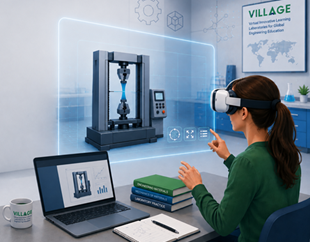
Instructor Engagement and Motivation in Virtual Engineering Education
The successful integration of Virtual Reality (VR) into engineering education depends not only on technology but also on the engagement and motivation of both instructors and students. While virtual laboratories, immersive simulations, and digital learning environments are becoming increasingly important, educators remain the key drivers of innovation in teaching and learning.
Within the VILLAGE project, a needs analysis involving 200 engineering instructors examined their perceptions, experiences, and expectations regarding VR-based engineering education. The results provide valuable insights into what motivates instructors and what challenges they face when adopting new technologies. Readers interested in exploring the complete findings can access the public deliverables available on the VILLAGE website. In particular, D2.2: Needs Analysis Report of Instructors provides a comprehensive overview of the study and its outcomes.
One of the most striking findings is the strong interest in VR despite limited practical experience. While 65.5% of instructors reported having no previous experience with VR in engineering education, a large majority still recognised its educational value. More than 63% of participants rated the importance of VR in engineering education as either 4 or 5 on a five-point scale. Instructors particularly highlighted the potential of VR to create engaging learning experiences (65%), enhance practical training (64%), and improve visualisation of complex engineering concepts (55.5%). These findings demonstrate a high level of motivation to explore innovative teaching approaches, even among educators who have not yet used VR in their courses.
However, motivation alone is not enough. The study revealed that many instructors require additional support before they can confidently implement VR-based learning environments. Professional development courses, pedagogical guidance for VR integration, and technical skills training emerged as the most requested support areas. In fact, 63% of instructors expressed a need for pedagogical strategies for VR integration, while 59.5% requested professional development opportunities related to VR-based education.
The analysis also identified several barriers that may negatively affect instructor engagement. Limited access to VR technologies, insufficient technological support, slow loading of 3D objects, and the time required to develop VR content were among the most frequently reported challenges. Additionally, more than half of the respondents stated that their institutions currently do not use VR-based technologies in educational processes, highlighting a significant gap between instructors’ interest and institutional readiness.
These findings suggest that sustaining instructor motivation requires more than providing access to technology. Educators need comprehensive support ecosystems that combine technical infrastructure, pedagogical guidance, training opportunities, and institutional commitment. Bridging the gap between enthusiasm for VR and practical implementation is essential for the successful adoption of virtual engineering laboratories. As engineering education continues its digital transformation, empowering instructors will be just as important as developing new technologies. By investing in faculty development, fostering confidence in VR adoption, and creating supportive learning environments, institutions can ensure that virtual engineering education reaches its full potential for both educators and students.
Author
Mehmet KARA
Early-Stage Researcher in VILLAGE Project
Ph.D. Candidate, Ege University


No responses yet