

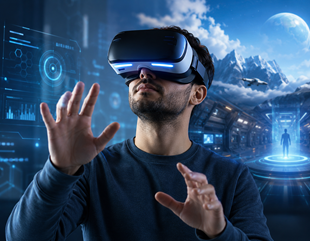
What is Virtual Reality(VR)?
Virtual Reality (VR), a technology that the tech world has been developing for many years, has now taken centre stage in everyday life, the business world, and the entertainment sector. Thanks to advancing display technologies, artificial intelligence integrations, and high-speed data transfer, this technology—which immerses users in a fully digital universe—has evolved from being merely a gaming tool into a revolution reshaping global industries. Today, across numerous fields ranging from education to healthcare, and from military simulations to architecture, virtual reality is opening the doors to a new era in human-computer interaction.
Virtual reality tools aim to engage the senses, primarily sight, but also touch and hearing. Virtual reality should not be confused with augmented reality. Augmented reality involves the use of artificial simulations within a real-world environment. In virtual reality, however, real people experience distinct scenarios within an entirely artificial environment.
Virtual reality technology can be categorised into various types depending on specific needs and usage scenarios. Here are the main types of virtual reality:
1. Fully Immersive VR
Fully immersive VR allows users to immerse themselves completely in a virtual environment. This type of VR typically utilises high-quality VR headsets and advanced motion-tracking systems.
- Features:
- High-resolution displays and a wide field of view.
- A realistic audio experience delivered via 3D sound systems.
- Real-time reflection of user movements into the virtual environment through motion-tracking devices.
2. Semi-Immersive VR
Although semi-immersive VR does not offer an experience as intense as fully immersive VR, it effectively places users within a virtual environment. This type of VR is typically delivered using large screens or projection systems.
- Features:
- A visual experience delivered via large screens or projection systems.
- Limited motion tracking and interaction capabilities.
3. Desktop VR
Desktop VR enables users to interact with a virtual environment on a computer screen. This type of VR is usually navigated using a keyboard, mouse, or game controllers.
- Features:
- Displayed directly on a standard computer screen.
- Interaction managed via keyboard, mouse, or game controllers.
4. Mobile VR
Mobile VR is a type of VR delivered via smartphones and mobile devices. This technology enables users to experience virtual environments by placing their mobile devices into specialised VR headsets.
- Features:
- Fully compatible with smartphones and mobile devices.
- Highly portable and easy to use.
5. Augmented Reality (AR) and Mixed Reality (MR)
Augmented reality (AR) is a technology that overlays virtual objects onto the real world. Mixed reality (MR) combines AR and VR technologies, enabling users to interact simultaneously with both the virtual and real worlds.
- Features:
- Seamless placement of virtual objects within the real-world environment.
- Direct interaction with both virtual and real-world elements.
Drawbacks and Challenges of Virtual Reality
Despite the exciting possibilities offered by virtual reality, there are several drawbacks that need to be taken into account. Firstly, the high cost of VR equipment can pose a significant barrier for many users, potentially limiting its widespread adoption. In addition, some users may experience motion sickness or physical discomfort due to the sensory mismatch between virtual and real-world movements. Furthermore, the limited availability of high-quality content may restrict the variety of experiences offered to users. Finally, prolonged use of virtual reality can lead to social isolation as users become increasingly immersed in virtual environments.
Advantages of Virtual Reality
On the other hand, virtual reality offers numerous advantages. One of its most significant benefits is an enhanced user experience. Virtual reality creates a profound sense of presence and engagement by allowing individuals to immerse themselves in realistic and interactive environments. Furthermore, virtual reality has proven to be highly effective in education and training by providing practical, hands-on experiences and simulations in fields such as medicine, aviation, and engineering. Virtual travel and exploration allow individuals to visit distant locations and historical sites without leaving their homes. Finally, businesses can utilise virtual reality for experiential marketing, allowing customers to interact with products thoroughly before making a purchase.
Applications of Virtual Reality
- Education: Virtual reality is widely utilised in various industries that offer training opportunities, such as the military, schools, and healthcare facilities. Training through virtual reality can lead to significant cost savings across almost any location and industry (including travel). It offers a more advanced learning experience compared to traditional books and videos, yielding higher engagement and a more positive outlook than video- or classroom-based training. The primary focus is on experiential learning; exploring the solar system or examining a coral reef up close using virtual reality helps ensure that more information is visually retained in the memory.
- Product Development: Testing products in virtual reality is straightforward and cost-effective. The product simply needs to be modelled in 3D software and then tested within the virtual environment as quickly as possible. Errors are identified more rapidly, and virtual reality-based product development significantly shortens the product’s design and testing phases.
- Psychological Treatment: In addition to virtual reality training for healthcare professionals, VR is also used in the treatment of psychological issues such as anxiety disorders. As seen in Virtual Reality Exposure Therapy (VRET), a triggering or frightening situation is simulated. Under the careful guidance of a therapist, patients can learn to manage their anxiety safely.
- Entertainment: Virtual reality is most commonly associated with the entertainment sector. Beyond standard video games, users can visit virtual reality theme parks or watch films in an immersive virtual cinema.
- Social Interaction: There are various applications that allow users to meet up with friends via virtual reality. Platforms such as VR Chat and Social VR provide virtual spaces where people can come together. Everyone can choose or create their own unique avatar, and users can communicate effortlessly via real-time voice chat.
The Future of Virtual Reality: How Will It Evolve?
Virtual reality is developing rapidly, and continuous breakthroughs are expected across various sectors. According to a recent report by the International Market Analysis Research and Consulting Group, the global virtual reality market is expected to reach $313.5 billion by 2032.
Below are some forecasts and predictions regarding the future of virtual reality:
The future of virtual reality is being shaped by its increasing accessibility. Previously limited to expensive, specialised equipment, virtual reality has become far more attainable with the emergence of affordable headsets and the integration of VR features into mobile devices. This increased accessibility is creating fresh opportunities for virtual reality applications across various sectors, such as business, healthcare, and education. This affordability will also enable a much wider audience to adopt the technology.
As demand for virtual reality grows, users can expect an even higher level of immersion, bringing experiences closer to real life. Virtual reality will continue to focus on creating hyper-realistic experiences by engaging multiple senses. With the rapid adoption of haptic gloves, specialised clothing, and spatial audio, research into incorporating the sense of smell into deeply immersive experiences will gain significant momentum.
Virtual reality will enable virtual workplace communication to become as effective as face-to-face interaction. For example, Nvidia is making high-resolution 3D video conferencing possible using only consumer webcams and AI-powered methods.
The integration of augmented reality with virtual reality is expected to open up new possibilities. For instance, augmented reality glasses will soon be able to overlay directions, points of interest, and relevant data directly into the user’s field of view, making navigation easier and more natural. This technology holds great promise not only for the travel and tourism industry but also for assisting those with visual impairments.
Ensuring safe and age-appropriate virtual experiences will be a major global concern in the future. In 2023, Meta lowered the minimum age for Quest accounts, enabling children aged 10 to 12 to have a parent-managed account for age-appropriate VR experiences. As VR devices become increasingly popular among young users, businesses and parents alike will seek robust controls for VR access.
In summary, this literature review demonstrates that virtual reality technology has the potential to be an extremely useful tool across a wide range of applications and a diverse array of fields. As a technology, VR is still in its relative infancy, yet more people are taking an interest in it and remain optimistic about the changes it could bring to their daily lives. Given how quickly modern society has adapted to personal computers and smartphones, VR has the opportunity to become the next major technological milestone that will eventually become commonplace in most homes.
REFERENCES
https://hopi.com.tr/son-teknoloji/hayaller-gercek-oluyor-sanal-gerceklik-nedir
https://www.simovate.com/blog/sanal-gerceklik-turleri-nelerdir
https://varwin.com/en/vr-development/vr-pros-and-cons
https://kolektifhouse.co/komag/sanal-gerceklik-nedir-gelecekte-nasil-karsimiza-cikacak
https://www.techtarget.com/whatis/definition/virtual-reality
https://pmc.ncbi.nlm.nih.gov/articles/PMC9517547/
Author
Emir ÖZGÜVEN
First Grade Student
Faculty of Education, CEIT Department, Ege University


No responses yet